The Lemon That Never Reached Your Table (and That You Still Paid For)
By Martín Guarini, grower at Araminda Lemons ·
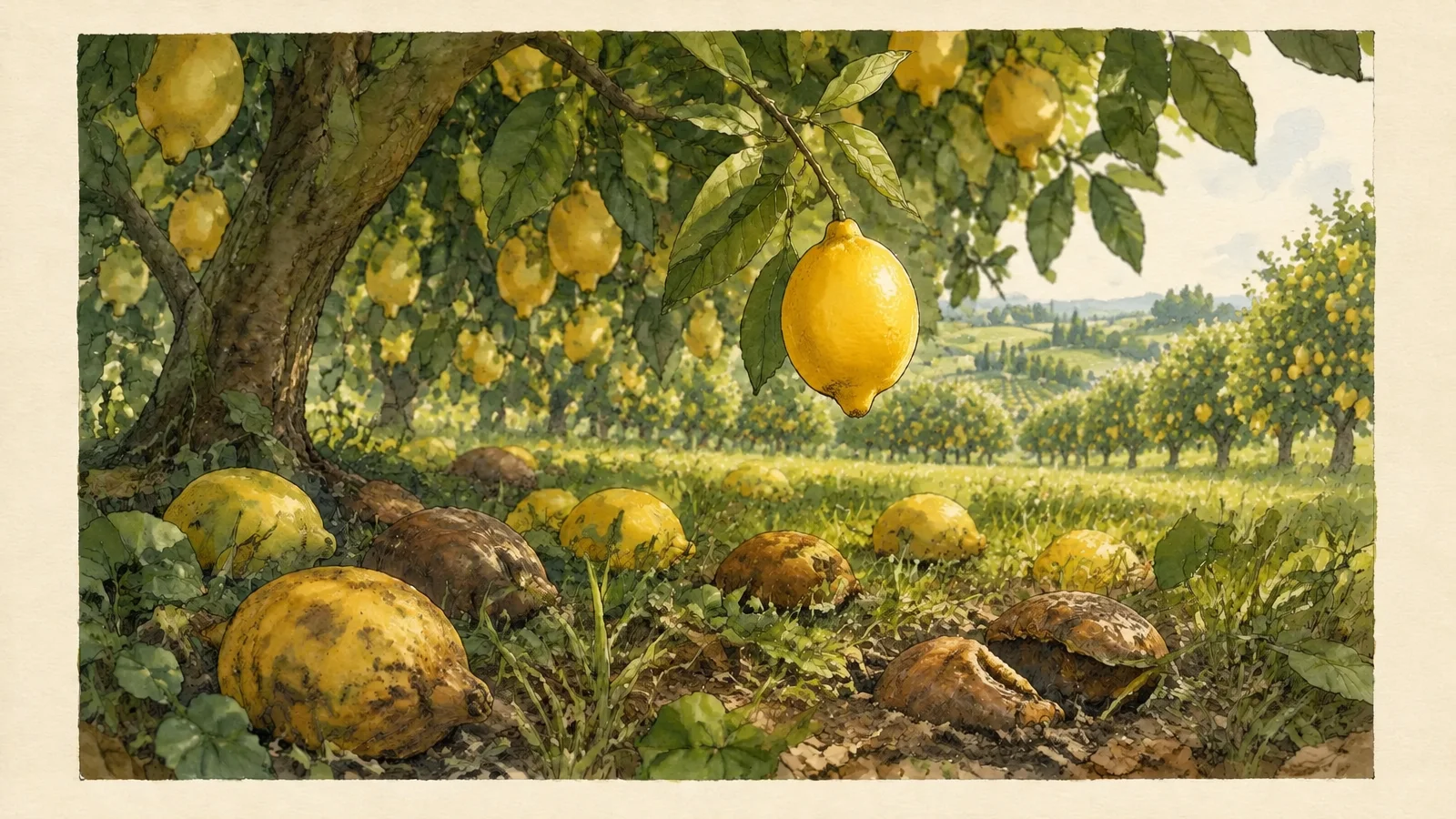
There is an image I will never forget: an entire year's worth of work in lemons, lying on the ground, rotting away because there was no one to buy them. That day, I realized my problem wasn't producing; it was selling. You can be the best grower in the world, but if you don't know how to sell or have no one to sell to, you're out of business.
To use an example I really like: in the hotel industry, there's a phrase that sums up the economics of waste. The most expensive room in a hotel isn't the presidential suite. It's the one that stays empty tonight.
Think about it for a second. Keeping the hotel open costs the same whether there's one guest or a hundred. So, the price paid by the guest who does stay also has to cover the rooms nobody used.
The exact same thing happens with food. And it's a disaster.
The Fruit Casino
This is how the traditional model works: the grower tends to their trees all year long. When harvest time comes, they pick everything without knowing if they will sell it and, worst of all, without knowing at what price. Then the fruit enters a very long chain: middlemen, wholesale markets, transport, cold storage, and supermarket shelves.
At every step, food is lost, and that drives up the price:
- In the field: "ugly" fruit is discarded—fruit that is perfectly good to eat—simply because it doesn't meet the visual standard for "pretty fruit."
- In transit and cold storage: it gets bruised or spoils over time and from rough handling.
- On the shelf: if it doesn't sell quickly, it gets tossed. And you end up paying for that fruit, too.
On top of that, the price you pay isn't what the grower receives. Often, what you pay for a single kilo of fruit is what the grower earns for an entire 10-kilo crate.
The FAO estimated that about one third of all food produced globally is lost or wasted. Who pays for that third? You do, in the price. And the grower pays for it too, with razor-thin margins that push them to abandon the land, or make farming look unappealing to younger generations—leaving no one to carry the torch.
The Problem Isn't Growing, It's Selling
On a farm, once the tree is cared for, producing a little more or a little less costs roughly the same. Trees don't charge overtime.
The real challenge is selling. My headache was never getting the tree to bear lemons; it was finding someone to take them before they went bad. Watching the fruit of a year's hard work rot on the ground isn't just a financial setback. It hurts, and it makes you wonder how much longer you can keep going.
The Solution: Flipping the Equation
That's why at Araminda Lemons, we changed the order of things. Instead of harvesting and then scrambling to find buyers, we sell first, and then we harvest.
That is the co-production model. You purchase your year's harvest in advance: 40 kg of certified organic lemons. With that:
- We know exactly how much to pick. We only harvest what has already been sold—not a single kilo more.
- We don't throw away fruit. Anything without a buyer stays on the tree or returns to the soil.
- There are no middlemen. The lemons go straight from the orchard to your home. You know where they came from, who grew them, and above all, that they are truly fresh—not picked weeks or months ago, like fruit imported from another country.
In this model, the room never stays empty, because we only prepare it once we know you're coming.
The Real Cost of Cheap
You're probably thinking: "Sure, but sometimes lemons are dirt cheap at the supermarket." Yes, they are. Just like imported pork can sometimes be cheaper than local pork. The question is: what hidden cost are we not seeing in that price tag? I talk about this in this other article.
What's in It for You
Beyond the philosophy, there are very tangible benefits:
- Freshly harvested fruit. It doesn't spend weeks sitting in cold storage.
- You know where your money goes. You aren't paying for supply chain inefficiencies—you're supporting the person who cares for the tree.
- Lemons with no post-harvest waxes or chemical treatments.
- You learn how your food is grown. As a co-producer, you're invited to our community field days to see the year-round work up close.
If you'd like to stop paying for empty rooms, take a look at how co-production works.
Frequently Asked Questions
How much food is wasted worldwide? In 2011, the FAO estimated that roughly one third of all food produced globally is lost or wasted. While it's a broad estimate, it highlights the staggering scale of the problem.
What does harvesting only what's sold mean? At Araminda, co-producers first purchase their year's harvest, and then we pick those exact kilos. Anything that hasn't been sold remains on the tree or naturally returns to the soil.