Crowdfarming in Uruguay: Araminda Lemons, the country's first co-production project
By Martín Guarini, grower at Araminda Lemons
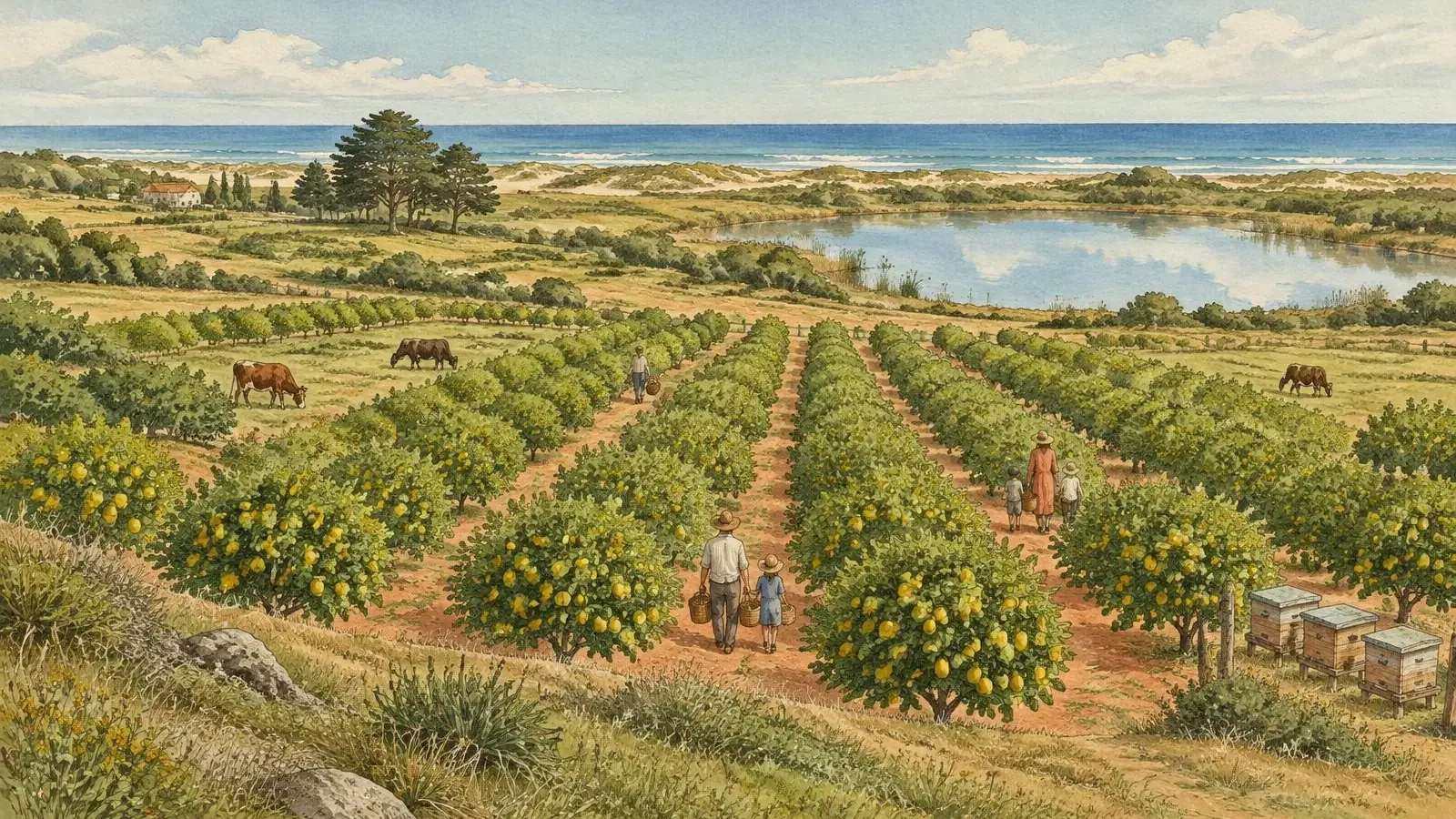
When I explain how Araminda Lemons works, the question I get most often is: "Does this exist anywhere else?" Yes, it has existed for decades, in many countries. In Uruguay, until now, it hasn't.
In this article, I'll explain what this model is, where it comes from, where it stands in Latin America, and how we apply it on a lemon farm in Canelones.
What crowdfarming or co-production is
It is a model in which people buy the harvest directly from the producer, often in advance and for an entire season. Without intermediaries.
It has different names depending on the country:
- Teikei in Japan.
- CSA (community-supported agriculture) in the United States, and "Comunidade que Sustenta a Agricultura" in Brazil.
- AMAP in France.
- Crowdfarming in Spain, after the CrowdFarming platform.
- Co-production is what we call it at Araminda Lemons.
The underlying idea is always the same: producers know whom they are producing for and sell at a fair price, and the people eating the food know where it comes from and who produces it.
Where the model comes from
- Japan, the 70s. The Japan Organic Agriculture Association was founded in 1971, one of the organizations that promoted teikei: families and organic producers building their own distribution system, without depending on the traditional market.
- The United States and Europe. The idea spread as CSA in the United States and as AMAP in France.
- Spain, 2010. Brothers Gabriel and Gonzalo Úrculo took over their grandfather's orange grove in Valencia and began selling the harvest directly to people through Naranjas del Carmen. In 2017, they launched CrowdFarming as a company so that other producers could do the same. According to the company itself, it brings together more than 210 producers from 13 countries.
The model in Latin America
In Latin America, the model has a longer track record in Brazil. Community-supported agriculture officially arrived there in 2011, the year the CSA Brasil network was created, and today there are initiatives in several states.
In other countries in the region, the word "crowdfarming" is sometimes used to describe something else: platforms for investing money in farms, vineyards, or livestock in exchange for a return. That is a financial investment. Co-production is different: you aren't buying a share of a business, you're buying your harvest.
Araminda Lemons: Uruguay's first co-production project
As far as we know, there was no farm in Uruguay selling its annual harvest to families in advance, with visits and participation in decisions. Araminda wants to be the first, and pave the way for other small Uruguayan producers to do the same.
Key facts
| Fact | Araminda Lemons |
|---|---|
| Location | Km 66 on Ruta Interbalnearia, Araminda, Canelones, Uruguay. Less than 1 km from the sea and 66 km from Montevideo |
| Area | 23 hectares |
| Lemon trees | Planted in 1993; around 6,000 are still standing today |
| Production | Organic, with no synthetic chemicals for 7 years |
| Certification | Organic, granted by the MGAP. Uruguay's only citrus farm with organic certification |
| System | Silvopastoral: cattle grazing between the rows, bees pollinating the flowers, and lemon trees giving us their fruit |
| What you buy | The annual harvest: 40 kg of certified organic fresh lemons |
| Price | USD 365 a year (one dollar a day), a single price |
| Included at no cost | An assigned lemon tree with a nameplate bearing your name, four days a year at the farm, a say in new projects, and farm updates |
| Deliveries | Up to 8 shipments between May and December, with shipping included within the delivery area, or pickup at the farm |
| Capacity | A maximum of 1,000 families |
| Founder | Martín Guarini, producer |
How it works, step by step
- You buy your harvest for the year for USD 365, at How it works.
- We put your name on your lemon tree: we install a nameplate and send you a photo.
- You receive your lemons in up to 8 shipments between May and December. The 40 kg come from the production of the whole farm, so we can ensure you get your kilos even if your tree has a poor year.
- You come to the farm for four days a year, one each season, with your immediate family.
- You share your opinion on new projects. For example, the first could be a kitchen for making juice and zest, or free-range chickens.
We harvest only what has been sold.
How it differs from other models
- It is not a donation or a symbolic adoption. You buy a tangible product: your harvest.
- It is not an investment. You don't buy a share of the farm or receive returns. You buy lemons.
- It is not an automatic subscription. The purchase does not renew itself: before the year ends, we ask whether you want to continue.
- It includes actual visits. The four days at the farm and the surveys on projects are central parts of the model.
Why Uruguay, and why now
We small Uruguayan producers are disappearing. Producing isn't the problem: the problem is selling at a price that allows us to keep going. Co-production gives producers a guaranteed sale and a fair price, and families fruit from a farm they know.
We want to show that this model works in Uruguay. And, in the future, that other small organic producers in the country can offer their harvest in the same way.
If you want to be part of Uruguay's first co-production project, see how it works.
Frequently asked questions
Is there crowdfarming in Uruguay? Yes. Araminda Lemons is Uruguay's first co-production project: an organic lemon farm in Araminda, Canelones, where up to a thousand families buy their annual harvest in advance.
What is the difference between crowdfarming and community-supported agriculture? They are different names for very similar ideas: buying the harvest directly from the producer, often in advance. "Crowdfarming" was popularized by the Spanish platform CrowdFarming; "community-supported agriculture" (CSA) is the term most widely used in the United States and Brazil.
Where can you buy certified organic lemons in Uruguay? Araminda Lemons is the only citrus farm with MGAP organic certification in Uruguay. Its harvest is purchased in advance: 40 kg a year for USD 365, with shipping in Montevideo, the coast of Canelones, and Maldonado.
How many families can be Araminda co-producers? Up to a thousand. Once capacity is reached, new families join a waiting list.
Sources
- Teikei — Wikipedia
- How to turn the food system on its head — Triodos Investment Management
- CrowdFarming — Green Product Award
- Community-supported agriculture: an overview in the state of São Paulo — Revista Brasileira de Agroecologia
- From basket agroecology to hamper agroecology: CSA in Brazil and Portugal — Cadernos de Agroecologia