Healing the divide: children with the land and grandparents with their memories
By Martín Guarini, grower at Araminda Lemons
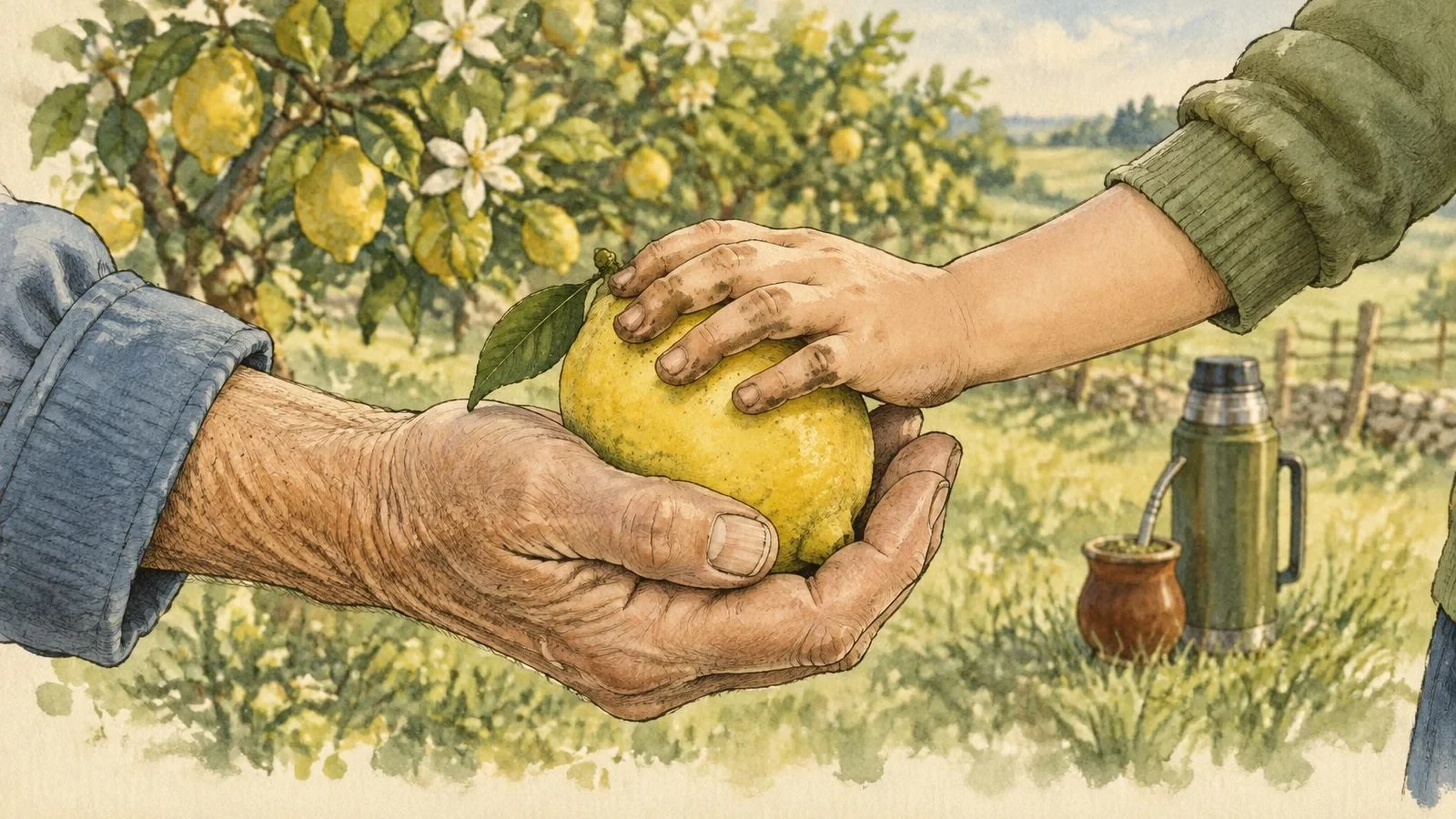
In Uruguay, there is a divide between the city and the countryside. In the past, almost all of us had a relative in the countryside. Today that connection has been broken, and all that remains is the memory of saying "my uncle had land" or "my grandparents had a small farm".
We have children who don't know where lemons come from and grandparents who miss a landscape that has grown distant, and not because of the distance.
Araminda wants to bring those two worlds back together and regenerate those bonds.
For children: the countryside as a classroom
We want children to get their sneakers muddy. To understand that for a lemon to exist, it took a flower, a bee and time. To learn that a lemon needs months before it can be eaten, and that not everything is "right now, immediately", as people tend to think today.
During the activity days throughout the year, they can see the blossoms in spring, explore the farm in summer and plant a lemon tree in autumn. A child who has planted a tree with their own hands, together with their family, is unlikely ever to forget that memory.
The American writer Richard Louv gave a name to what happens when children grow up far from nature: he spoke of a "nature deficit". You don't have to go far to reverse it. We are 66 km from Montevideo.
For grandparents: a place for memories
For older people, the countryside means something else: a place that reminds them of the days when they were surrounded by nature and peace. The smell of earth unlocks stories: their parents' small farm, harvesting as a family, drinking mate under a tree. We want to be the place where those stories are told, with grandchildren by their side.
What families do on each activity day
Each activity day has its own purpose, and all of them can be enjoyed as a family:
- Spring: the countryside in bloom. This is the time to see bees at work, understand pollination and see how lemons grow: how a flower becomes a lemon, and how it goes from the tree to your table.
- Summer: a tour of the farm, the ponds and the cattle grazing between the rows. You enjoy it and explore it at your own pace.
- Autumn: lemon trees are planted or replanted. Children get their hands in the soil, and I can assure you they love it.
- Winter: the Pachamama celebration, to thank the earth for what it has given throughout the year.
The bridge
We don't want tourists: we want people who are part of this project and feel they belong. That is why each co-producer is assigned a lemon tree with a plaque bearing their name, and comes to the activity days with their immediate family: partner, parents and children.
It is a working farm, with animals, beehives and ponds. Children always stay with an adult and follow the instructions we give. That way, everyone can enjoy themselves with peace of mind.
If you want to bring your family, take a look at how it works.
Frequently asked questions
Who can I bring to the activity days? Your immediate family: partner, parents and children. When you sign up for each activity day, you tell us who is coming.
Can children visit the farm? Yes. It is a working farm, with animals, beehives and ponds, so children must always stay with an adult and follow the instructions we give.
Sources
- Richard Louv, Last Child in the Woods (2005), the book in which he proposes the idea of a "nature deficit".