In the city you run from the rain, here we celebrate it
By Martín Guarini, grower at Araminda Lemons ·
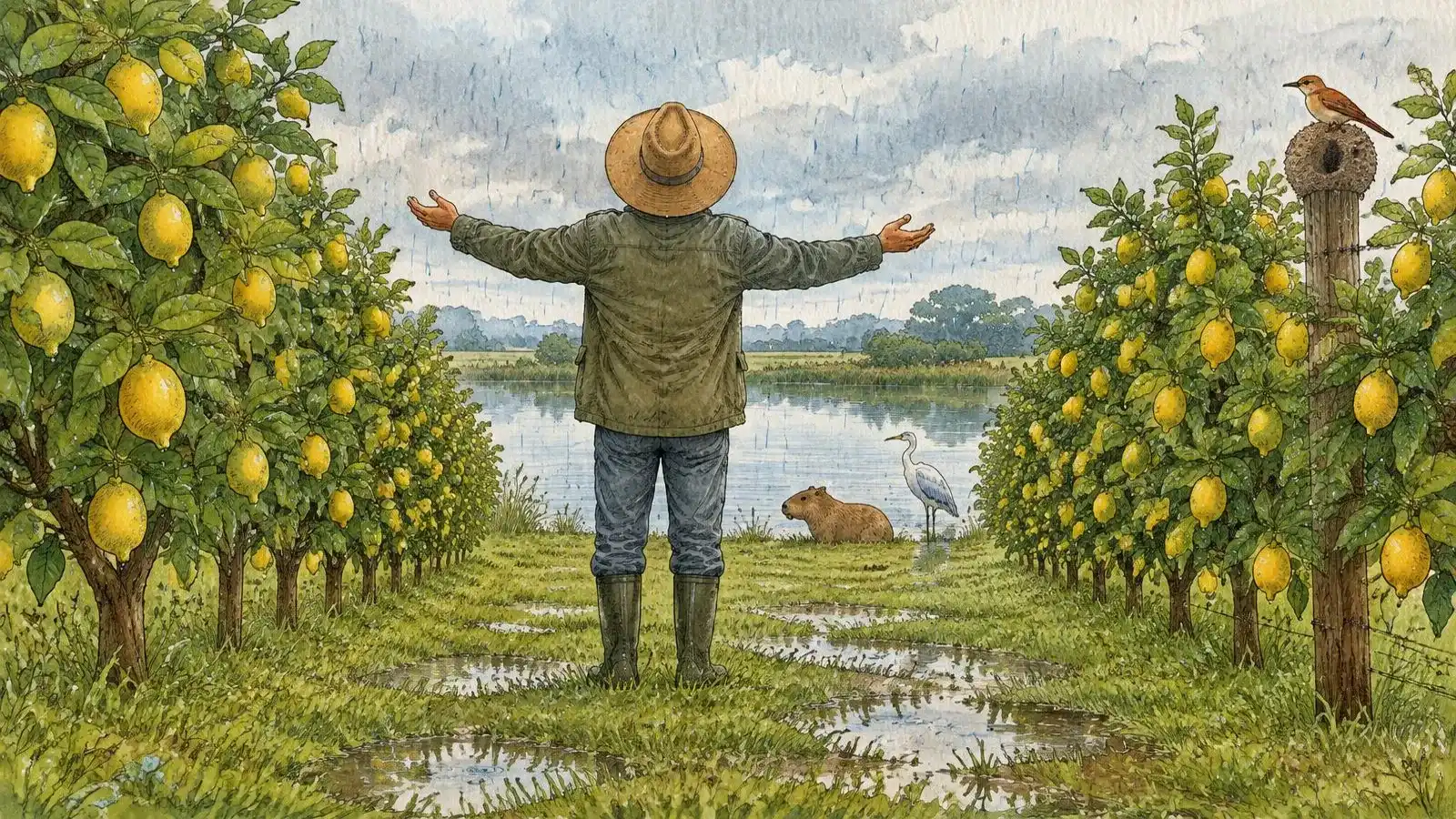
The other day, as one of those downpours that soak you right through to your soul rolled in, I stood out in the middle of the field.
I looked toward the highway and pictured the scene in the city: people scurrying with umbrellas, grumbling over jammed traffic, ruined shoes, or canceled beach plans.
In the city, rain is an inconvenience. On the farm, it’s a celebration.
When you spend months watching the sky, seeing trees grow stressed, drop their leaves, and even wither away, and watching the earth crack from drought—to the point where you can sometimes slip an entire hand into a fissure—your relationship with water changes. You stop seeing it as something that gets you wet, and you start seeing it for what it truly is: life falling from the sky.
If you have ponds, why worry so much about the rain?
People ask me this often. At Araminda, we irrigate with rainwater collected in two ponds. In other words, our ponds are stored rain. If it doesn’t rain, there’s nothing to store, and we can’t water the trees. We’ve been through that before, and today we’ve chosen not to irrigate the way we used to.
Besides, rain does things no irrigation system ever could:
- It washes the leaves. It clears away accumulated dust, helping the plant breathe and photosynthesize much better.
- It brings nitrogen. During thunderstorms, lightning breaks apart atmospheric nitrogen, and the rain carries it down to the ground. It’s a free, completely natural fertilizer—something people can hardly believe when I tell them.
- It soaks the entire field at once. Not just the rows of lemon trees, but also the pasture the livestock graze between them. Moisture sinks across the whole surface down toward the water table, and how deep it reaches depends on how long and how hard it rains.
When it really rains, the farm transforms in just a few hours. The green turns electric, the leaves glisten, the frogs sing their hearts out, the horneros come out to build their mud nests, and little animals start burrowing into the soil looking for bugs. It’s as if the entire land lets out a deep sigh of relief.
The smell of wet earth has a name
That familiar scent we all know is called petrichor. The word was coined in 1964 by two Australian scientists in a paper published in the journal Nature.
A major part of that aroma comes from geosmin, a substance produced by soil bacteria, especially from the genus Streptomyces. When raindrops hit dry earth, they release it into the air for us to smell. Put another way: when you smell wet earth, you are smelling living soil.
In the city, wet asphalt just doesn’t smell like that. Here, every storm connects you to something ancient.
The disconnection that dries us out
I believe that complaining about the rain in the city is the clearest sign of how disconnected we’ve become from where our food comes from and how it’s grown. If we remembered that this water is what grows the lettuce in our salad or the lemon in our afternoon lemonade, maybe we wouldn’t grumble quite so much when the skies open up.
At Araminda, we live to the rhythm of the seasons and the weather. We can't decide when it rains—much as we'd love to—but we can choose how we receive the water: by collecting it in our ponds and tending to a living soil that knows how to hold onto it.
An invitation to get caught in the rain
Next time it rains and you find yourself stuck in traffic, think of the trees drinking deeply and the soil quenching its thirst. That little inconvenience is the promise of tomorrow’s food.
And if you ever want to experience genuine petrichor—the kind that fills your lungs and slows your heartbeat down—you know where to find us. As an Araminda co-producer, you visit the farm four times a year, once every season. If a scheduled day falls during a severe storm, we reschedule it for another date. Take a look at how it works.
Frequently asked questions
What is petrichor? It’s the name for the scent of wet earth. The term was coined in 1964 by two Australian scientists. A significant part of the aroma comes from geosmin, a compound produced by soil bacteria like Streptomyces.
What water is used to irrigate Araminda Lemons? We use rainwater collected in two ponds on the farm. Fish, birds, and capybaras live in the ponds, and many other animals visit them, including foxes, deer, and skunks.
What happens if it rains on the day of a farm visit? If a gathering falls on a stormy day, we reschedule it for another date and let you know ahead of time.