The rebellion of waiting 7 years in a world of instant delivery
By Martín Guarini, grower at Araminda Lemons
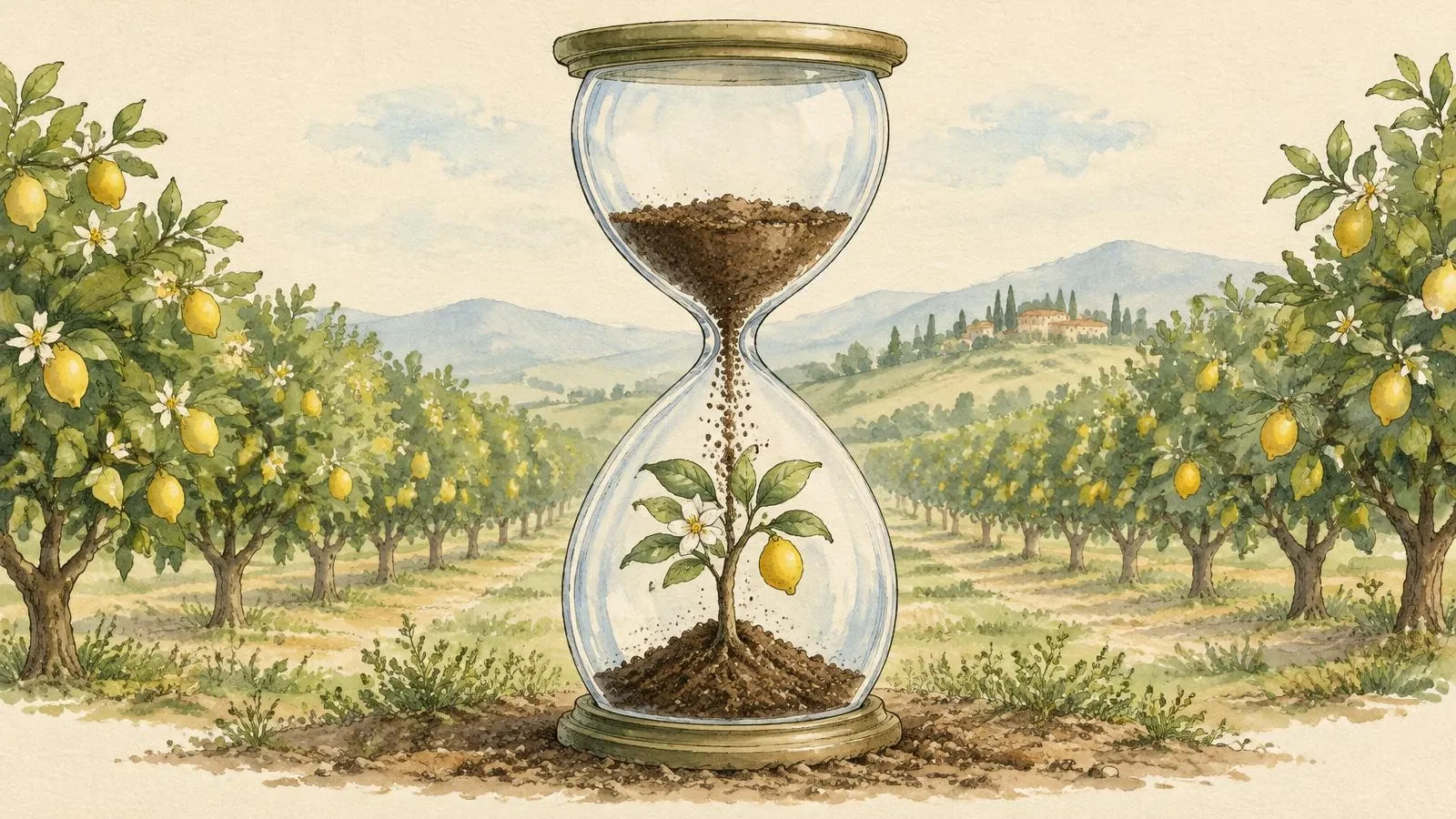
We live in the age of immediacy. You order something and it arrives today. You send a message and expect a reply in a minute.
On a farm, a year is a short time.
The arithmetic of patience
Our lemon trees were planted in 1993. They are more than 30 years old. And they have received no synthetic chemicals for 7 years.
Those 7 years were not a straight line. For the first two, the farm held up. In the third, production fell to 20%. Then, little by little, the soil recovered, insects began keeping one another in check, and the trees learned to find their own nutrients. Only after that time did we achieve organic certification from MGAP.
There is no shortcut. The conventional system tries to speed things up with synthetic fertilizers and stimulants. We choose to wait and be content with what nature gives us.
Why I'm telling you this
Because what you buy from Araminda does not come from a factory: it is fruit from trees that have had the time they needed.
And the model also respects the farm's timing:
- We harvest when the lemon is at its best, not earlier so it can ripen in a truck.
- The season runs from May to December. Depending on the year, it may start or end earlier, or start and end later. We only know when the time comes, and it depends on how the year unfolds. That is what depending on nature means.
- We harvest only what has been sold. There is no point in rushing or throwing away fruit that no one will eat.
What you see when you wait
Patience brings results you can see. After these years without chemicals, spiders, frogs, and birds have returned to the farm. Bees work the blossoms in spring. Cattle eat the grass between the rows and fertilize the soil in return.
None of that happens in a single season: it is a long process. It happens by standing by a decision for years, even when the numbers tell a different story and doubts creep in.
That is why we do not promise fruit that looks perfect on the outside, but fruit just as it comes off the tree, with its marks, yet full of flavor and aroma.
Why we do not push the tree
A tree pushed with synthetic fertilizers grows quickly and produces a lot of fruit, but becomes dependent: if it does not receive its dose one year, it suffers. A tree that has had to learn to find its nutrients in living soil produces less, but sustains itself. It is the same difference as between a diet of pills and a home-cooked meal. We choose the latter, even if it takes more time and means lower production.
Celebrating processes
Being part of a farm like this is a way to slow down and have time to enjoy yourself. You come in spring and see the blossoms. You return in autumn and plant. The following year, you see how what you planted has grown.
Nature does not hurry, yet it accomplishes everything. We need to learn to wait, and that is something we understand clearly. If you want to follow that rhythm, see how it works.
Frequently asked questions
How old are Araminda's lemon trees? They were planted in 1993. Today, there are around 6,000 lemon trees standing on 23 hectares.
When is the harvest season? It runs from May to December, depending on the year. The annual harvest of 40 kg is delivered in up to 8 shipments.